
Cashflow 101, Part 4: Factoring VS. a Loan
Factoring isn't a loan, and the difference shows up on your books in a way most business owners never see.
Remember Bob from Part 1? In case you missed it, Bob is the owner of a small business that makes specialty barrels. Bob spent his last $150 building a barrel, which he sold to Barrels of Fun for $300, and then because of Barrels of Fun's payment terms, had to wait 60 days to get paid. For 60 days he had $0 in the bank, which meant no money to build more barrels, and no money or work for Sam (his faithful employee).
Bob has two ways out of that wait. He can go to the bank and borrow money, or he can factor his invoice. Both put cash in his account today. But they do very different things to his business and have a different impact on his books. Let's take a look at why in this lesson.
Option A: The loan
Let's say Bob walks into his bank and asks for $300. The bank agrees to lend it to him for one year at 10% interest.
That sounds easy, but here's what it actually means:
Bob gets $300 today.
He owes the bank a payment of $26.37 every month for 12 months, about $316 in total.
The first payment is due on Day 30. Barrels of Fun doesn't pay him until Day 60.
So a month after taking the loan, Bob has a bill to pay and still no money coming in. Remember, Bob only gets paid every 60 days, but the bank wants to be paid every 30.
And here's the bigger question: would a bank even lend to Bob? He has a brand-new business, $0 in the bank, and exactly one customer. Most banks would say no, or ask him to personally guarantee the loan with his house.
Option B: Factoring
Instead of borrowing, Bob sells his $300 invoice to a factoring company. The factor offers him a 75% advance and charges a 5% fee.
Here's how that plays out:
Day 1: The factor pays Bob $225 (75% of $300). So now Bob has $225 he can spend today.
Day 60: Barrels of Fun pays the $300 invoice to the factor.
Day 60: The factor keeps its $15 fee (5% of $300) and sends Bob the remaining $60. Now Bob has an additional $60 to spend.
Bob gets $285 of his $300 in the end, $225 of it right away. He has no monthly payments, and no monthly payment worries, and he doesn't owe anyone anything, because here's the good news: The factor gets repaid from Barrels of Fun, not from Bob.
That's right, the factor isn't counting on Bob to pay them back. It's counting on Barrels of Fun, so what matters is whether Barrels of Fun pays its bills. Bob's brand-new business and empty bank account matter much less. There is no follow up from Bob required, he can just concentrate on his work.
But even more importantly, when Bob gets a loan from the bank he gets the $300 once, until he pays it back; but with factoring, he can sell as many invoices as he has, as long as he keeps making and selling barrels for Barrels of Fun, the factor will continue to give him money against his invoices.
What each option does to Bob's books
This is the part almost nobody explains. Every transaction in your business changes two things on your books, never just one. When cash comes in, something else has to change to explain where it came from. That's what is meant by double-entry accounting.
With the loan, cash goes up $300, and so does what Bob owes: a $300 debt to the bank. With factoring, Bob trades one thing he owns (the invoice) for another (cash). Nothing new is owed to anyone.
Here’s Bob’s balance sheet the day after, side by side:
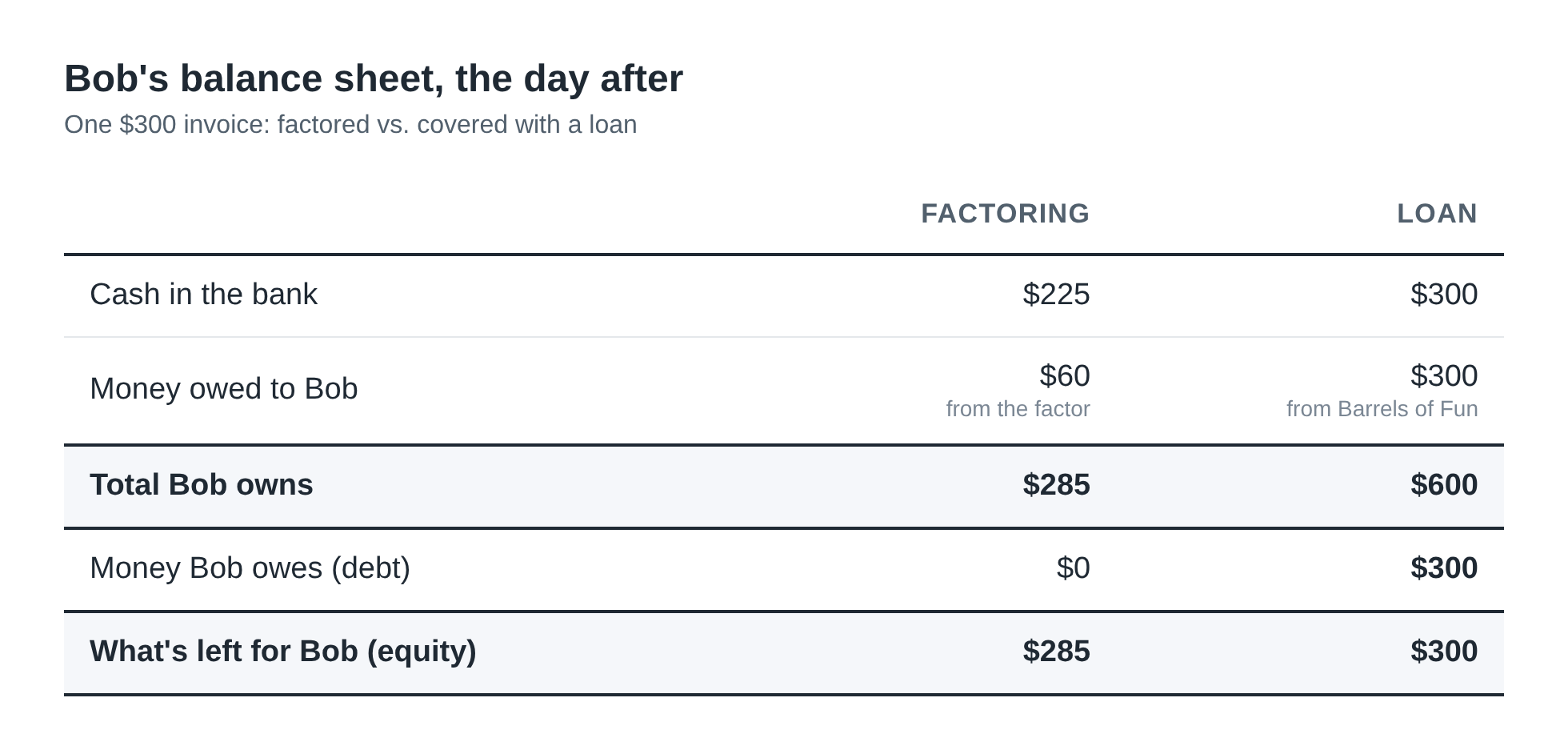
The loan makes Bob's business look bigger, $600 instead of $285, but half of that belongs to the bank. Equity is the number that matters: what Bob owns minus what he owes. It's within $15 in both cases. That $15 is the factoring fee.
The difference is that $300 of debt. When Bob goes back to the bank next time, or applies for a lease on a bigger shop, they'll see it. Debt affects how much more he can borrow, and on what terms.
So which one costs more?
Let's be honest: factoring does. Bob pays $15 to get his money 60 days early. The bank charges him about $16 in interest to use $300 for a whole year. Day for day, the loan is cheaper.
So why would anyone factor? Because the price isn't the only thing you're comparing. Here's what Bob's extra cost buys him:
Cash he can actually get. A bank loan only helps if the bank says yes. A factor looks at your customer, not your bank balance.
No payments while you wait. Bob doesn't owe a cent until his customer pays, and then the factor collects from the customer, not from Bob.
No debt on his books. His balance sheet stays clean, which keeps his options open for the next loan or lease.
Funding that grows with him. The loan stops at $300. Every new invoice Bob writes can be factored, so his cash grows as his sales do. (We'll play this out over a whole year in Part 5.)
The question isn't "which is cheaper?" It's "what is getting paid today worth to my business?" In Part 1 we saw what waiting 60 days costs: Bob turned $150 into $9,600 instead of $614,400.
The catch: ask your factor one question
Everything above assumes Bob's factor is non-recourse. Not every factor is, and this is the one question you must ask before you sign anything.
Non-recourse: If Barrels of Fun goes out of business and never pays, that's the factor's loss. Bob keeps his $225.
Recourse: If Barrels of Fun never pays, Bob has to buy the invoice back. He owes the factor the money, which starts to look a lot like a loan, and his accountant may record it as one.
One more thing to know. Non-recourse protects you if your customer can't pay. It doesn't usually protect you if your customer won't pay because of a problem with your work. If Bob's barrels leak, that's still Bob's problem.
So before you factor, ask: "Is this recourse or non-recourse, and what exactly does it cover?"
Quiz time
When Bob factors his invoice, his debt goes up by
$300
$225
$15
$0. He sold something he owned; he didn't borrow anything.
The bank wants its first loan payment on Day 30, but Barrels of Fun pays Bob on Day 60. Bob should
Hope the bank is in a forgiving mood
Pay his employee Sam a month later and hope Sam sticks around.
Have thought about when his money comes in before he signed up for payments that go out
All of the above, but mostly the third one
A factoring company decides whether to fund Bob mostly by looking at
Bob's credit score and how long he's been in business
Whether Barrels of Fun pays its bills
How nice Bob's barrels are
Bob's house
Factoring costs more than a bank loan, so
Factoring is always a bad deal
Never compare the two; it hurts your head
You should compare what each one costs with what getting paid today is worth to your business
Before signing with a factor, the one question you must ask is
"Do you like barrels?"
"Is this recourse or non-recourse, and what exactly does it cover?"
"I wonder if I can get Sam to come back to work now?"
"Are you single? Asking for a friend."
Answer key
$0. Bob sold something he owned; he didn't borrow anything, so his debt doesn't change.
All of the above, but mostly the third one. Before you sign up for payments going out, know when your money is coming in.
Whether Barrels of Fun pays its bills. The factor is counting on Bob's customer to pay, not on Bob.
Compare what each one costs with what getting paid today is worth to your business. Cheaper isn't always better if the cheaper option leaves you waiting.
"Is this recourse or non-recourse, and what exactly does it cover?" It decides who takes the loss if your customer never pays.