
The cheaper option isn't the one that grows your business. Over one year, Bob ends up with nearly five times more money by factoring than by borrowing, even though factoring costs him far more in fees.
In Part 4, we looked at one $300 invoice from Bob (our business owner) to Barrels of Fun (Bob's customer). Bob could borrow from the bank or factor the invoice, and we saw what each choice did to his books. Today we're going to play out a whole year and watch what happens to his profit when Bob keeps going with either option, or continues to do nothing at all.
Here are the rules, so we're comparing apples to apples:
Bob starts with $150 in the bank, just like in Part 1.
Each barrel costs $150 to make (supplies and Sam) and sells to Barrels of Fun for $300 on 60-day terms.
Bob builds and invoices once a month, and puts every dollar he can into making more barrels.
The loan: $300 for one year at 10%, repaid at $26.37 a month.
Factoring: a 75% advance on each invoice and a 5% fee, with the rest paid to Bob when Barrels of Fun pays.
For comparison, in Part 1, with no financing at all, Bob turned his $150 into $9,600 by the end of the year.
The loan year
With the loan, Bob starts the year with $450: his own $150 plus the bank's $300. Because he's a responsible business owner, he always sets aside enough for next month's loan payment before he spends anything on barrels.
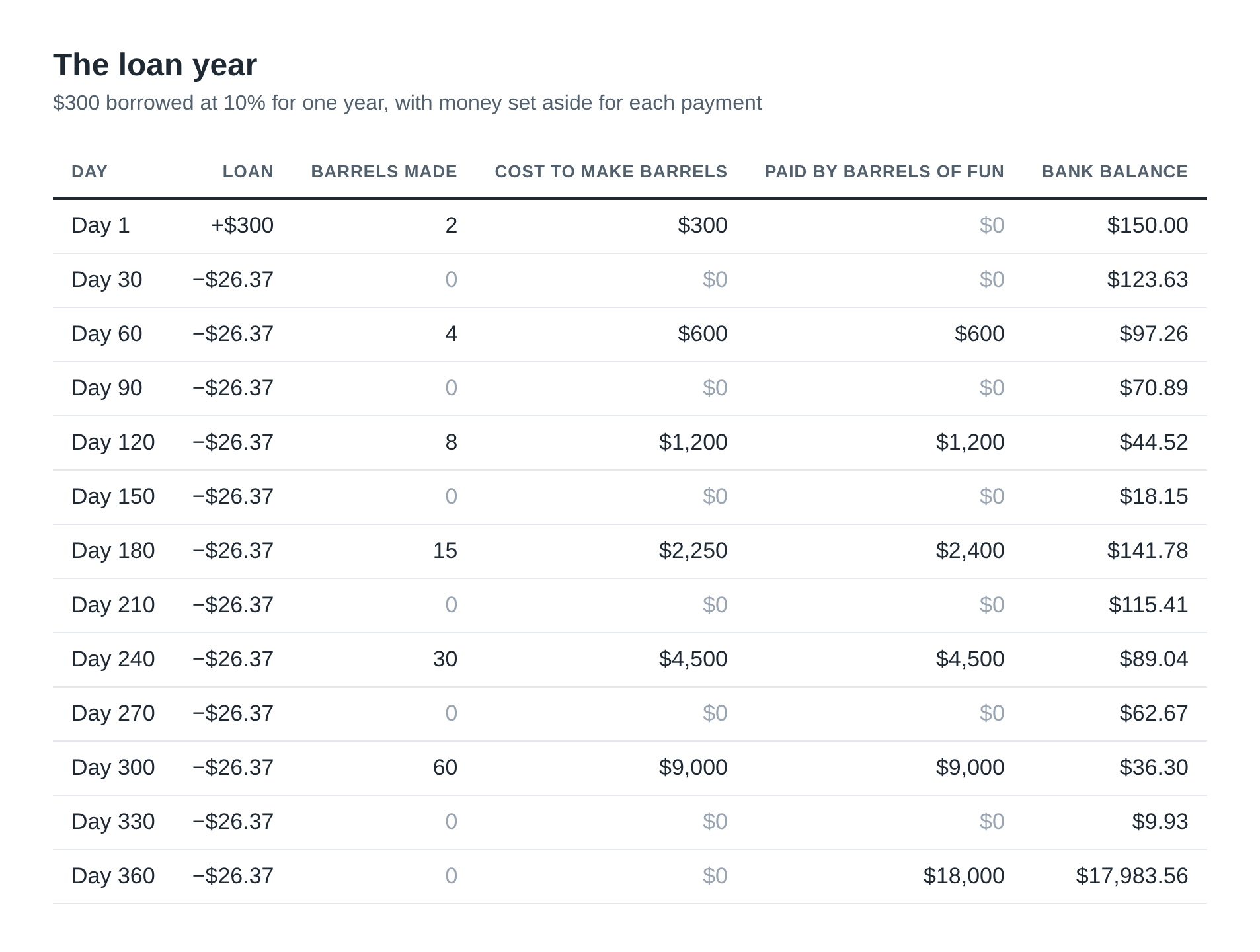
The loan helped, but only once. It let Bob build 2 barrels on Day 1 instead of 1. After that, he's right back to the problem from Part 1: building every other month and waiting 60 days to get paid.
And look at the bank balance column. Every month, money sits in Bob's account waiting for the bank instead of going into barrels. On Day 1 he had $450, enough for 3 barrels, but he could only build 2 because he needed to cover his first payment. That one missing barrel follows him all year.
Bob finishes the year with $17,984 and his loan paid off. That's almost twice what he made with no financing. Not bad, but let's see what factoring does.
The factoring year
With factoring, Bob starts with just his own $150. But every time he builds a barrel and invoices, the factor sends him 75% right away. Sixty days later, when Barrels of Fun pays, the factor sends him the rest, minus its 5% fee.
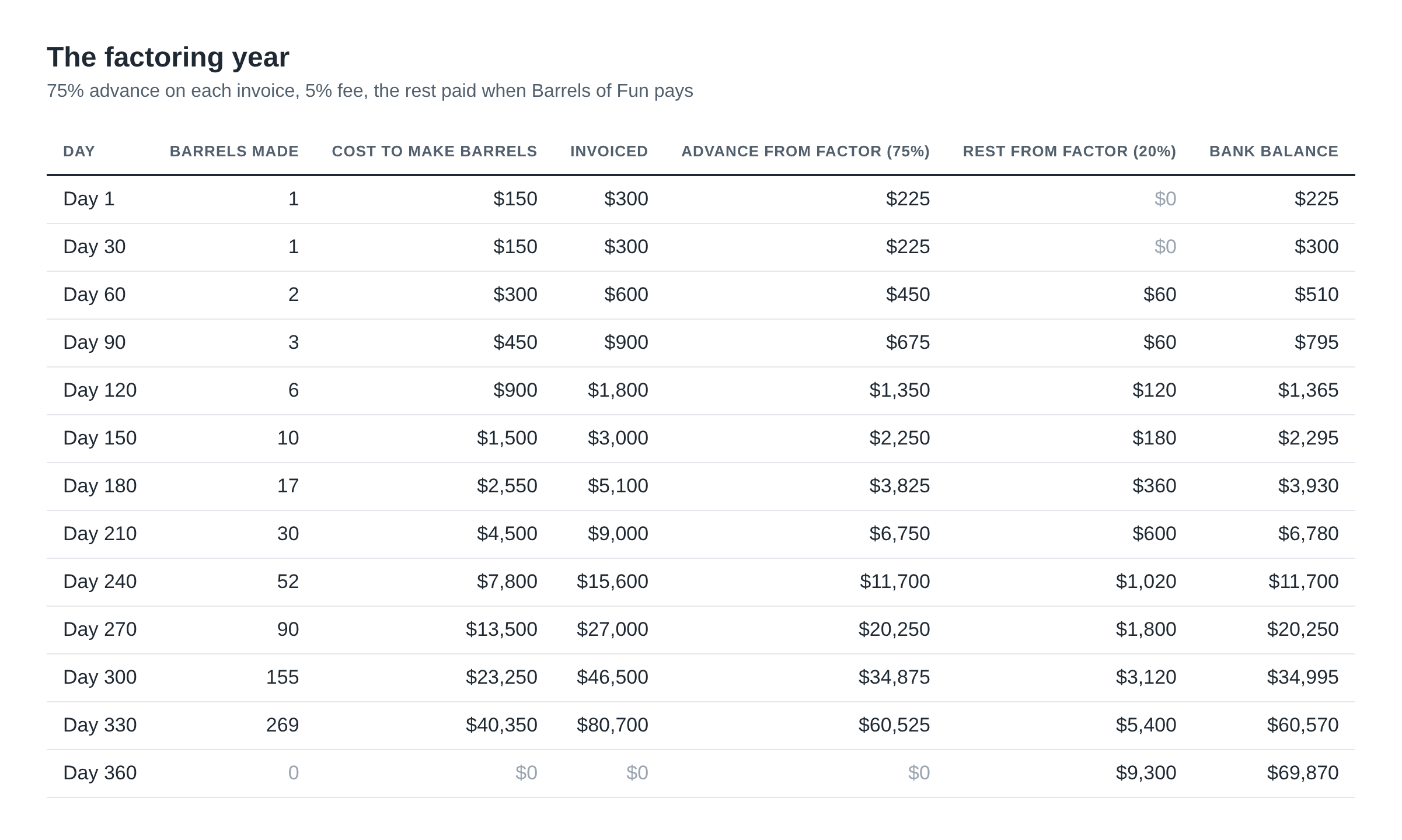
The first month is slow. Bob only gets $225 back on a $300 invoice, so he can't double right away. But notice what's different: Bob builds barrels every single month. No more waiting 60 days with nothing to do, and Sam (Bob's employee) has steady work all year.
Bob ends the year with $69,870 in the bank, and the factor still owes him $16,140 from his Day 330 invoice. That's $86,010 in total. And he doesn't owe anyone a cent.
Side by side
Here's how Bob's year ends under each option, starting from the same $150:
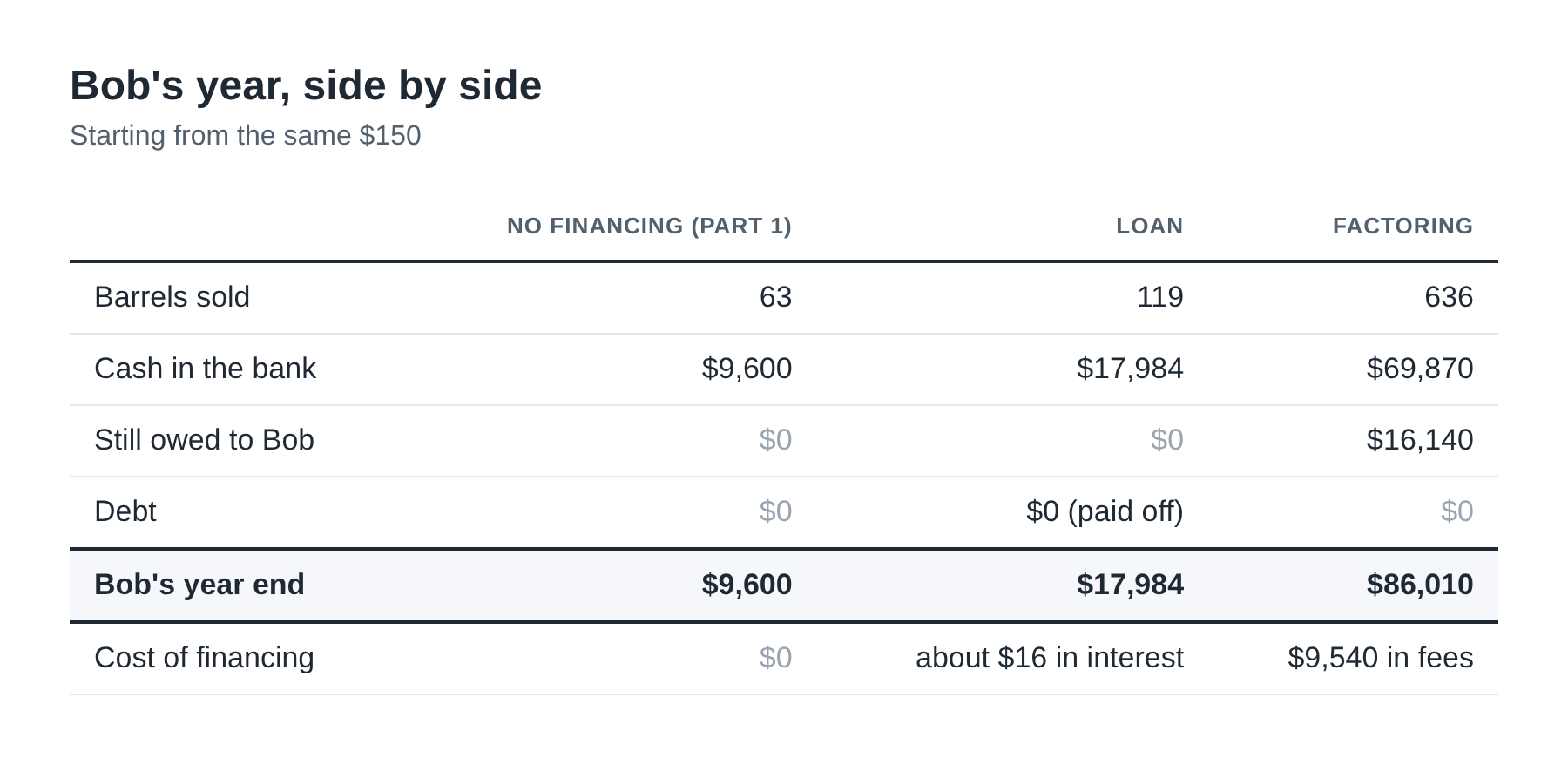
With factoring, Bob sold more than five times as many barrels as with the loan and finished with nearly five times as much money.
But factoring cost $9,540!
It did. Bob paid the factor $9,540 in fees over the year, and the bank only about $16 in interest. If you only look at cost, the loan wins by a mile.
But look at why the fees were so high: Bob paid 5% on every invoice, and he sold $190,800 worth of barrels. With the loan, he only sold $35,700. The fees grew because his business grew.
After paying every one of those fees, Bob still finished the year $68,026 ahead of where the loan left him.
The cheaper option isn't the one that grows your business. A loan gives you money once. Factoring gives you your own money back every time you invoice, so you can keep working instead of waiting. The real question isn't "what does this cost?" It's "what will this let me build?"
A reality check
Of course, Bob can't go from 1 barrel to 269 barrels a month without a bigger shop, more people than Sam, and a customer who wants that many barrels. Real businesses hit limits, and growth never goes in a straight line. The numbers are here to show the difference between the options, not to promise you a barrel empire.
But the example actually understates things. Most of our clients invoice every two weeks, in line with their payroll. If Bob did the same, the gap between the loan and factoring would be far bigger than what you see here.
That's why, in my experience, factoring is the number one way to scale a business if you have the drive to do so. A bank lends you an amount based on what you've already done, and it comes with the obligation of a monthly payment. A factor funds what you're doing right now, and grows right along with you. If you have the customers and the will to keep up with them, factoring makes sure cash is never the thing holding you back.
Quiz time
1) Over the year, which option cost Bob the most?
a) The loan
b) Factoring
c) Doing nothing
d) Sam's lunch budget
2) Which option left Bob with the most money at the end of the year?
a) The loan
b) Factoring
c) Doing nothing
d) Hiding cash in a barrel
3) Bob's factoring fees grew every month. That's because
a) He was selling more barrels every month
b) Barrels of Fun kept ordering more
c) Sam finally had full-time work
d) All of the above. Bob's business was growing!
4) Why didn't the loan help Bob grow more?
a) The bank gave him $300 once, and he still waited 60 days for every payment
b) He had to set money aside for loan payments instead of building barrels
c) Both of the above
d) Banks don't like barrels
5) The cheapest financing option is always the best one for your business.
a) True
b) False
c) Only on Tuesdays
Answer key
Factoring. $9,540 in fees, against about $16 in loan interest.
Factoring. $86,010, nearly five times what the loan left him with.
All of the above. Rising fees are a sign of a growing business: more barrels, more orders, more work for Sam.
Both of the above. A loan is money once, and paying it back takes money out of your business every month.
False. The cheaper option isn't the one that grows your business.